Perusta sinäkin oma Blogaaja.fi blogi ilmaiseksi >>
Lainaa.com

The Crucial Role of Surface Preparation in Pipe Shot Blasting

Surface preparation is one of the most important stages in pipe manufacturing, maintenance, coating, and finishing. Before a pipe is painted, coated, lined, welded, or subjected to further surface treatment, its surface must be properly cleaned and prepared. Even a high-quality coating can fail prematurely if the underlying steel surface contains rust, mill scale, oxides, old coatings, oil, or other contaminants. Shot Blasting Machine, Shot Blasting Machine Manufacturers, Robotic Shot Peening Machineshot peening machineRobotic Shot Peening Machine Manufacturers , shot blasting machine manufacturers in india , shot peening machine manufacturers in india, shot peening machine manufacturers, Roll Etching Machine Manufacturers, Shot Peening, Roller Conveyor Type Shot Blasting Machine,

https://sfecindia.net/

https://sfecindia.net/shot-peening-machine.html

https://sfecindia.net/robotic-shot-peening-machine.html


https://sfecindia.net/roller-conveyor-type-shot-blasting-machine.html

https://sfecindia.net/what-is-shot-peening/

Pipe shot blasting provides an efficient and controlled method for preparing pipe surfaces. By projecting abrasive media at high velocity onto the pipe, a shot blasting machine removes unwanted surface contaminants while creating a suitable surface profile for subsequent coating or finishing operations.

For manufacturers and industrial users, understanding the relationship between surface preparation and pipe shot blasting is essential for achieving consistent quality, longer coating life, improved production efficiency, and reduced maintenance costs.

What Is Surface Preparation?

Surface preparation is the process of cleaning and conditioning a pipe’s surface before a subsequent manufacturing or finishing operation.

Depending on the application, a pipe may contain:

  • Mill scale
  • Rust and corrosion
  • Oxides
  • Paint or old coatings
  • Welding residues
  • Dirt and dust
  • Oil and grease
  • Manufacturing contaminants
  • Loose surface particles

If these contaminants are not removed properly, they can interfere with coating adhesion and create defects in the finished product.

The objective of surface preparation is therefore not simply to make the pipe look clean. It is to create a clean, uniform, and suitably roughened surface that can support the next manufacturing process.

Why Surface Preparation Matters in Pipe Manufacturing

Pipes are commonly used in demanding environments such as oil and gas, construction, power generation, water infrastructure, automotive manufacturing, chemical processing, and industrial equipment.

Many of these applications require pipes to receive protective coatings. The performance of the coating depends heavily on the condition of the substrate.

Poor surface preparation can lead to:

  • Poor coating adhesion
  • Premature peeling
  • Flaking
  • Corrosion beneath the coating
  • Uneven coating thickness
  • Reduced service life
  • Increased maintenance requirements
  • Higher production costs

Proper preparation, on the other hand, creates a more reliable foundation for painting, powder coating, galvanizing, lining, or other surface treatments.

How Pipe Shot Blasting Improves Surface Preparation

A pipe shot blasting machine uses abrasive particles, commonly steel shot or steel grit, to impact the external surface of the pipe.

The impact action performs two important functions.

First, it removes unwanted materials such as rust, scale, and old coatings.

Second, it creates a controlled surface texture or profile. This profile increases the effective surface area and helps many protective coatings mechanically anchor to the pipe.

The result is a surface that is both clean and properly conditioned for subsequent processing.

The Pipe’s Journey Through a Shot Blasting Machine

A typical automated pipe shot blasting process may include several stages.

1. Pipe Loading

Pipes are loaded onto the machine’s conveyor or handling system. Depending on pipe dimensions and production requirements, systems may use rollers, rotating mechanisms, or specialized pipe handling equipment.

2. Surface Exposure

The pipe is positioned so that abrasive media can reach the required surface area.

For cylindrical pipes, controlled rotation can be particularly important because it allows the blasting system to treat the circumference more uniformly.

3. Abrasive Blasting

Blast wheels or other abrasive delivery systems accelerate the shot or grit toward the pipe surface.

The abrasive impact removes contaminants and breaks down tightly bonded scale and corrosion.

4. Surface Profiling

The blasting action also produces a controlled anchor profile. The required profile depends on the pipe material, coating system, abrasive type, and application requirements.

5. Abrasive Recovery

Modern machines typically collect used abrasive and separate reusable media from dust and contaminants.

This helps improve abrasive utilization and supports continuous industrial production.

6. Dust Removal

A dust collection system removes airborne particles generated during blasting.

Effective dust extraction is important for machine performance, workplace cleanliness, visibility, and environmental control.

7. Inspection

After blasting, the pipe surface can be inspected for cleanliness, consistency, and surface profile before proceeding to coating or another finishing operation.

Surface Cleanliness and Coating Performance

One of the biggest reasons manufacturers invest in automated pipe shot blasting equipment is to improve coating performance.

A coating requires a properly prepared substrate. If rust, scale, oil, or other contaminants remain underneath the coating, the bond between the coating and the metal can be compromised.

Over time, moisture and corrosive elements may penetrate weak areas and initiate corrosion.

Proper blasting helps remove these contaminants and provides a more consistent substrate for coating application.

This is particularly important for pipes used outdoors or in aggressive industrial environments.

Creating the Right Surface Profile

Cleaning alone is not always enough.

A properly selected blasting process creates microscopic peaks and valleys across the metal surface. This texture is commonly referred to as the surface profile or anchor profile.

The coating can penetrate and mechanically grip this prepared surface.

However, the profile must be appropriate for the coating system. Excessively aggressive blasting can create an unnecessarily rough surface, while insufficient blasting may not provide adequate adhesion.

Therefore, parameters such as abrasive type, abrasive size, blasting intensity, exposure time, and pipe movement should be carefully controlled.

Importance of Consistent Pipe Rotation

Pipe geometry creates a unique challenge for surface preparation.

If a cylindrical pipe is blasted without proper movement or rotation, certain areas may receive more abrasive impact than others. This can result in inconsistent cleaning and surface profile.

Automated pipe shot blasting machines can incorporate controlled rotation and material handling systems to provide more uniform exposure.

This is especially valuable for high-production applications where hundreds or thousands of pipes may need to be processed.

Manual vs. Automated Pipe Shot Blasting

Manual blasting can be suitable for small-scale or highly customized operations, but it becomes increasingly difficult to maintain consistency as production volume increases.

Automated systems offer several advantages:

  • Consistent blasting intensity
  • Better surface uniformity
  • Higher production capacity
  • Reduced manual labor
  • Improved process control
  • More predictable coating performance
  • Better abrasive recovery
  • Reduced operator exposure to blasting environments

For industrial pipe manufacturers, automation can therefore transform surface preparation from a labor-intensive operation into a repeatable production process.

Choosing the Right Pipe Shot Blasting Machine

The ideal machine depends on the pipe and production requirements.

Important considerations include:

Pipe Diameter

The machine should accommodate the minimum and maximum pipe diameters required by the production line.

Pipe Length

Long pipes may require specialized conveyor and handling arrangements.

Material

Carbon steel, stainless steel, alloy steel, and other materials can require different blasting approaches.

Production Volume

High-volume manufacturing environments may benefit from continuous automated systems, while lower-volume operations may require more flexible equipment.

Surface Condition

New pipes with mill scale may require a different blasting setup from pipes containing heavy corrosion or existing coatings.

Required Surface Finish

The desired cleanliness grade and surface profile should be considered when selecting abrasive media and machine parameters.

Integration With Other Equipment

For large production lines, pipe shot blasting equipment can potentially be integrated with loading, unloading, painting, drying, inspection, and material-handling systems.

Abrasive Selection

Abrasive selection has a direct effect on the blasting result.

Common abrasive materials include:

  • Steel shot
  • Steel grit
  • Cut wire shot
  • Other application-specific abrasive media

Steel shot generally produces a different surface effect from angular steel grit. The selection should therefore be based on the required cleaning level, surface profile, material condition, coating specification, and machine configuration.

Using the wrong abrasive can increase consumption, reduce productivity, or produce an unsuitable surface profile.

Shot Blasting Parameters Matter

Even the right machine and abrasive cannot guarantee consistent results if operating parameters are poorly controlled.

Important parameters include:

  • Blast wheel speed
  • Abrasive flow rate
  • Pipe rotation speed
  • Conveyor speed
  • Blast coverage
  • Abrasive size
  • Number and positioning of blast wheels
  • Exposure time
  • Dust extraction performance

A properly optimized combination of these parameters helps achieve repeatable surface preparation.

Pipe Shot Blasting for Corrosion Protection

Corrosion protection is one of the most important applications of pipe surface preparation.

A protective coating acts as a barrier between the metal and its surrounding environment. However, the barrier can only perform effectively when it adheres properly to the substrate.

Shot blasting removes corrosion products and contaminants while preparing the surface for protective coating systems.

This makes pipe shot blasting particularly valuable in industries where pipes are exposed to:

  • Moisture
  • Chemicals
  • Saltwater
  • Outdoor weather
  • High temperatures
  • Industrial chemicals
  • Underground environments

Proper surface preparation can contribute significantly to the long-term performance of the complete pipe protection system.

Applications of Pipe Shot Blasting

Pipe shot blasting is used across numerous industries.

Oil & Gas

Pipelines and industrial piping often require surface preparation before protective coating systems are applied.

Construction

Structural and industrial pipes may be blasted before painting or other finishing processes.

Power Generation

Pipes used in power plants may require controlled surface preparation before protective treatment.

Automotive

Certain tubular components can require blasting for cleaning, finishing, or coating preparation.

Water Infrastructure

Water pipelines and related components can require carefully controlled surface preparation before protective coatings or linings.

Steel and Fabrication Industries

Steel pipe manufacturers and fabricators can use automated blasting systems to improve production consistency.

Quality Control After Shot Blasting

Surface preparation should not end when the pipe exits the blasting chamber.

Quality control can include checking:

  • Surface cleanliness
  • Surface profile
  • Visual uniformity
  • Remaining scale or rust
  • Dust contamination
  • Abrasive residues
  • Coating readiness

Depending on the application, manufacturers may use recognized surface preparation standards and appropriate inspection methods.

The goal is to ensure that every pipe meets the required specification before moving to the next stage.

Common Surface Preparation Problems

Several problems can reduce the effectiveness of pipe shot blasting.

Under-Blasting

Insufficient blasting may leave mill scale, rust, or contaminants on the surface.

Over-Blasting

Excessive blasting can waste abrasive and energy and may create an unnecessarily aggressive surface profile.

Uneven Blasting

Poor pipe rotation or incorrect blast coverage can create inconsistent surface preparation.

Incorrect Abrasive

An unsuitable abrasive can produce the wrong surface profile or inefficient cleaning.

Poor Dust Separation

Ineffective dust collection and abrasive separation can contaminate the blasting process and increase operating costs.

Incorrect Machine Settings

Improper conveyor speed, abrasive flow, or blast wheel settings can affect the final result.

How Automation Improves Pipe Surface Preparation

Modern automatic pipe shot blasting machines can use controlled material handling, variable-speed drives, automated abrasive circulation, dust collection, and monitoring systems.

Automation provides greater process repeatability than manual operations.

For manufacturers handling large quantities of pipe, this can lead to:

Consistent quality → Better coating adhesion → Longer protection → Lower rework → Higher productivity

Automation is especially valuable when customers require consistent surface preparation across large production batches.

Pipe Shot Blasting and Overall Production Efficiency

Surface preparation is sometimes treated as a secondary manufacturing operation. In reality, it can influence the efficiency of the entire finishing line.

A poorly prepared pipe may need:

  • Reblasting
  • Additional inspection
  • Coating removal
  • Recoating
  • Manual cleaning
  • Additional handling

Each additional operation increases production time and cost.

A properly designed and optimized pipe shot blasting system can reduce these problems by delivering consistent surface preparation at the beginning of the finishing process.

Conclusion

The quality of surface preparation directly influences the performance of downstream coating and finishing operations. For pipe manufacturers and industrial users, pipe shot blasting provides an efficient way to remove rust, mill scale, oxides, and other contaminants while creating a controlled surface profile.

The effectiveness of the process depends on more than simply blasting the pipe. Machine design, abrasive selection, pipe rotation, blast coverage, operating parameters, dust collection, and quality inspection all contribute to the final result.

As industries demand longer-lasting coatings, higher production efficiency, and more consistent quality, automated pipe shot blasting machines are becoming an increasingly important part of modern surface preparation lines.

For companies looking to improve pipe cleaning and coating preparation, selecting the right shot blasting equipment and optimizing the complete surface preparation process can provide significant advantages in quality, productivity, and long-term corrosion protection.

https://medium.com/@pawangaur89550/the-crucial-role-of-surface-preparation-in-pipe-shot-blasting-6660b5a37822?source=user_profile_page———0————-1872dab6bd67———————- 

Shot Peening: Definition, Mechanics, Process, and Industrial Applications

Shot peening is a specialized cold-working surface engineering process designed to enhance the fatigue life and mechanical durability of metal components. By bombarding a metal part with thousands of spherical particles—known as shot—under strictly controlled kinetic conditions, shot peening introduces a layer of beneficial high-magnitude compressive residual stress at the component’s surface.

Shot Blasting Machine, Shot Blasting Machine Manufacturers, Robotic Shot Peening Machineshot peening machineRobotic Shot Peening Machine Manufacturers , shot blasting machine manufacturers in india , shot peening machine manufacturers in india, shot peening machine manufacturers, Roll Etching Machine Manufacturers, Shot Peening, Roller Conveyor Type Shot Blasting Machine,

https://sfecindia.net/

https://sfecindia.net/shot-peening-machine.html

https://sfecindia.net/robotic-shot-peening-machine.html


https://sfecindia.net/roller-conveyor-type-shot-blasting-machine.html

https://sfecindia.net/what-is-shot-peening/


In demanding mechanical environments like aircraft engines, automotive transmissions, and industrial power generation, cyclical stress leads to micro-cracking and eventual structural failure. Shot peening acts as a primary defense mechanism against fatigue failure, stress corrosion cracking (SCC), fretting fatigue, and erosion, significantly extending the operational lifespan of critical load-bearing parts.

1. Shot Peening vs. Shot Blasting

While shot peening and shot blasting share similar machinery and delivery mechanisms, their fundamental metallurgical objectives, media standards, and process controls are entirely distinct.

                 TYPICAL RESIDUAL STRESS PROFILE


    Tensile (+)  |—————————–

                 |  \                         /  (Internal Tensile Balance)

   Stress (MPa)  |—\———————–/——————-

                 |    \                     /

  Compressive (-)|     \___________________/

                 |   Depth below surface (mm)


  • Shot Blasting is primarily a chemical-free cleaning, deburring, or surface preparation technique. Its goal is material removal, rust/scale removal, or roughing a substrate prior to painting or coating. The media used is often angular (grit) to scour the surface.
  • Shot Peening is a precise metallurgical surface-enhancement process. Its goal is plastic deformation without material removal. The media used must be strictly spherical to prevent surface notch formation, and every process parameter—including velocity, media size, exposure time, and impact angle—is calibrated to induce a predictable compressive stress profile.
Parameter / Feature Shot Peening Shot Blasting
Primary Objective Induce residual compressive stress to prevent fatigue Clean, scale, rust, or etch surface for coatings
Media Shape Strictly spherical (Cast steel, ceramic, glass, cut wire) Angular grit or broken/irregular shot
Surface Impact Micro-dimpling via plastic deformation Abrasion, scouring, and material removal
Process Control High (Almen intensity, saturation curves, coverage %) Low to Medium (Visual cleanliness standards like SSPC/NACE)
Effect on Fatigue Life Increases significantly (often 200% to 1000%+) Neutral to harmful (can introduce surface micro-notches)
Governing Standards AMS 2430, AMS 2431, SAE J442, MIL-S-13165 SSPC-SP 10/NACE No. 2, ISO 8501-1

2. The Science and Metallurgy of Shot Peening

To understand how shot peening prevents mechanical failure, one must understand how metallic fatigue cracks initiate and propagate.

The Mechanics of Residual Compressive Stress

When a high-velocity spherical shot strikes a metallic surface, it exceeds the material’s yield strength, causing a localized permanent (plastic) deformation. This impact creates a tiny rounded impression or dimple on the surface.

As the surface layer attempts to expand laterally due to this plastic strain, the underlying elastic core of the cold metal resists the expansion. This constraint forces the deformed surface layer into a state of high compressive residual stress, balanced by a lower-level tensile stress deeper within the core of the part.

      [ Spherical Shot Impact ]

                   |

                   v

  +———————————+  <- Plastically Deformed Surface Layer

  | (((( Compressive Stress ))))    |  <- Prevents crack initiation/propagation

  +———————————+

  |    (( Internal Tensile Core ))  |  <- Sub-surface elastic balance

  +———————————+


Preventing Fatigue Crack Initiation and Propagation

Fatigue failure requires two concurrent conditions:

  1. Cyclic loading during operation.
  2. Tensile stress at or near the surface.

Cracks almost always initiate at surface discontinuities, tool marks, grain boundaries, or inclusions where operational tensile stresses concentrate. Because crack growth requires tensile stress to pull atomic bonds apart, a pre-existing layer of compressive residual stress offsets applied operational tensile loads.

For a crack to propagate through a peened surface layer, the applied external tensile load must first overcome the static compressive stress built into the surface. As a result, the effective stress experienced by the component remains below its threshold for fatigue crack growth.

Secondary Benefits

In addition to standard bending and torsional fatigue protection, shot peening provides critical secondary metallurgical benefits:

  • Stress Corrosion Cracking (SCC) Mitigation: In corrosive environments (e.g., marine atmosphere or chemical processing), tensile stresses accelerate intergranular cracking. Compressive stress shields the alloy from environmental stress corrosion.
  • Fretting Fatigue Resistance: Prevents micro-fractures caused by small-amplitude oscillatory sliding between tightly fitted mating parts (e.g., turbine blade dovetail joints).
  • Work Hardening: On austenitic stainless steels and work-hardenable alloys, the plastic deformation increases surface hardness, improving wear resistance.
  • Closing Surface Micro-Pores: Reduces micro-porosity in cast metal components, increasing density at the outer skin.

3. The Step-by-Step Shot Peening Process

Executing an industrial shot peening operation requires a systematic sequence of preparation, processing, and verification steps.

Phase 1: Pre-Peening Preparation and Masking

Before a component enters the blast chamber, it must be thoroughly degreased, cleaned, and inspected. Surface contaminants such as oil, grease, or heavy scale cushion shot impacts and disrupt energy transfer.

  • Flaw Inspection: Parts undergo non-destructive testing (NDT)—such as dye penetrant or magnetic particle inspection—to ensure no pre-existing cracks exist prior to peening.
  • Masking: Areas that must remain unpeened (such as ultra-precise bearing journals, internal threads, or razor-sharp knife edges) are covered with rubber-based tapes, polyurethane boots, or custom steel fixtures.

Phase 2: Media Selection and Qualification

Media is selected based on part geometry, base metal hardness, and target stress depth. Media must be sorted using vibration screens and spiral separators to remove broken, non-spherical, or undersized particles.

Phase 3: Setup and Intensity Calibration (Almen Strip Testing)

Machine operators adjust air pressure, wheel RPM, shot flow rate, nozzle distance, and angle of incidence. Before peening actual components, the stream intensity is calibrated using Almen strips mounted on a dummy fixture representing the part’s geometry to establish a saturation curve.

Phase 4: Peening Execution

The part is positioned inside an automated, enclosed cabinet. Robotically controlled nozzles or multi-axis manipulators rotate and translate the part through the blast stream to ensure uniform media impact across all specified surfaces.

Phase 5: Post-Peening Cleaning, Inspection, and Stress Relief

  • Shot Removal: Parts are blown down with compressed air, washed, or demagnetized to remove residual shot particles or dust.
  • Coverage Inspection: Evaluated under optical magnification or via fluorescent tracer dyes under ultraviolet light.
  • Corrosion Protection: Ferrous parts receive an immediate rust inhibitor or oil bath, as fresh cold-worked surfaces are highly susceptible to flash rusting.

4. Critical Process Parameters and Quality Control

Shot peening is a process-dependent treatment; because residual stress cannot be visually measured without destructive testing (e.g., X-ray diffraction), process controls must be rigidly maintained. Quality relies on two primary pillars: Intensity and Coverage.

Intensity & The Almen Strip System

Peening intensity measures the kinetic energy transferred by the blast stream to the target surface. Developed by John O. Almen at General Motors, this standardized metric uses thin, flat strips of spring steel (SAE 1070) subjected to the shot stream on one side only.

When peened, the strip expands on the impacted surface while the unpeened side remains unchanged, causing the strip to bow into an arc. The height of this arc (measured in thousandths of an inch or millimeters using a specialized dial gauge) defines the Almen Arc Height.

   UNPEENED ALMEN STRIP                  PEENED ALMEN STRIP

+—————————+       /—————————\  <- Expanded surface

+—————————+      /—————————–\

                                                 | Arc Height

                                                 v (Measured via Almen Gauge)


Almen Strip Types

There are three standard Almen strip thicknesses designed to measure different intensity ranges:

Strip Type Thickness Recommended Intensity Range Typical Applications
N-Strip 0.031 in (0.79 mm) Low Intensity (0.002 – 0.008 in N) Thin sheet metal, delicate aluminum parts, glass bead peening
A-Strip 0.051 in (1.30 mm) Medium Intensity (0.004 – 0.024 in A) General automotive & aerospace parts, steel gears, springs
C-Strip 0.094 in (2.39 mm) High Intensity (>0.020 in A / C-range) Heavy forgings, landing gear cylinders, high-strength structural steels

The Saturation Curve and the 10% Rule

Intensity is not simply the arc height after an arbitrary exposure time; it is defined by saturation. Saturation occurs when doubling the exposure time increases the arc height by 10% or less.

 Arc Height ^

             |                         * (2T exposure)

             |                   *—– 

             |             *—-/  <- Arc height increases <= 10% when time doubles

             |       *—-/

             | *—-/ |

             |/_______|_____________________> Exposure Time

                     T (Saturation Time)


  1. Multiple Almen strips are exposed to the shot stream for varying time increments (e.g., 5s, 10s, 20s, 40s).
  2. The arc heights are plotted against time.
  3. The lowest point on the curve where doubling the time ($T \rightarrow 2T$) results in a $\le 10\%$ increase in arc height is designated as the Almen Intensity.

Coverage Verification

Coverage refers to the percentage of the component surface area that has been indented by shot impacts.

  • 100% Coverage: The entire target surface is covered by overlapping dimples, leaving no unpeened original surface visible.
  • 200% (or higher) Coverage: Represents exposing the part to the shot stream for twice (or a multiple of) the time required to achieve 100% coverage.

Coverage Measurement Techniques

  1. Visual Magnification (10x): Inspection under an optical loupe or stereo microscope to check for unpeened micro-gaps.
  2. Fluorescent Tracer Dyes (Peen-Scan / Dyescan): A liquid ultraviolet-fluorescent coating is applied to the part and allowed to dry. As the part is peened, the shot impacts break away the fluorescent coating. Under a blacklight (UV), any unpeened areas glow brightly, revealing incomplete coverage immediately.

Shot Media Types and Selection Guide

The choice of media directly dictates surface finish, dimple size, and potential surface contamination issues.

                   SHOT MEDIA CLASSIFICATIONS

                                |

      +————————-+————————-+

      |                         |                         |

[ Metallic ]               [ Glass ]                 [ Ceramic ]

  ├── Cast Steel (S-Series)  └── Silica-free Spheres   └── Zirconia-based

  └── Cut Wire (CW-Series)                                 Beads


  1. Cast Steel Shot (Spherical): The standard workhorse of the industry. Produced by atomizing molten steel into water. Graded by hardness (e.g., Regular Hardness 45-52 HRC, Special Hardness 55-62 HRC for ultra-high-strength steels).
  2. Conditioned Cut Wire (CW): Manufactured by cutting high-tensile steel or stainless steel wire into lengths equal to its diameter, then rounding the sharp edges mechanically (”conditioned”). Offers high consistency, minimal breakdown, and long cycle life.
  3. Glass Beads: Chemically inert, silica-free spherical glass media. Ideal for peening non-ferrous alloys (aluminum, titanium, brass) where steel contamination would cause galvanic corrosion. Leaves a bright, smooth satin finish.
  4. Ceramic Beads: Formulated from molten zirconia and silica. Offers higher density and impact energy than glass beads while remaining inert and non-contaminating. Highly resistant to shattering.
Media Type Density (g/cm3) Hardness Range Primary Best Uses
Cast Steel Shot ~7.8 45–62 HRC Structural steel, heavy gears, automotive axles
Conditioned Cut Wire ~7.8 45–60 HRC Aerospace structural parts, high-stress springs
Glass Beads ~2.5 46–50 HRC Aluminum airframe skins, medical implants, stainless steel
Ceramic Beads ~3.8 50–65 HRC Titanium turbine blades, complex geometric dies

5. Equipment and Delivery Systems

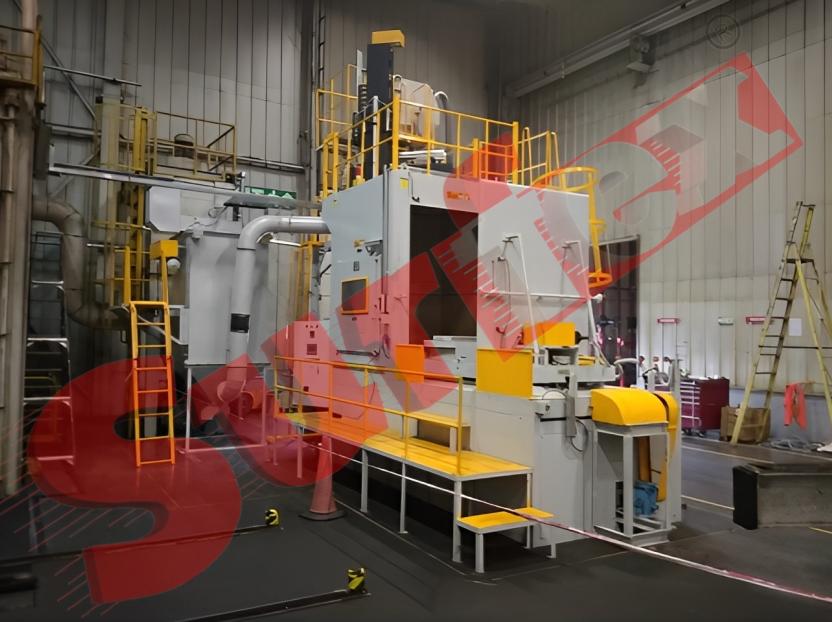
Shot peening machines fall into two main categories based on how the shot media is accelerated: Pneumatic Air Blast Systems and Centrifugal Wheel Systems.

Pneumatic Air Blast Systems

Air blast systems use compressed air to propel media through a precision nozzle directed at the part.

  • Direct Pressure Systems: Shot media sits in a pressurized vessel (pressure pot). When activated, air forces the media out of the pot and down the blast hose into the nozzle at high kinetic energy. Excellent for high-intensity requirements and deep compressive stress profiles.
  • Suction / Venturi Systems: Compressed air blowing through the nozzle creates a vacuum that draws shot up from an unpressurized hopper. Less powerful than direct pressure systems, but highly precise for low-intensity applications (e.g., glass bead peening).

DIRECT PRESSURE SYSTEM                   SUCTION / VENTURI SYSTEM


 Pressure Pot                            Air Line —-> [ Nozzle ]

   [ Media ]                                               ^

      |                                                    | (Siphon Vacuum)

      v                                                    |

 High Pressure Air —> [ Nozzle ]                       [ Media Hopper ]


Centrifugal Wheel Systems

Centrifugal wheel machines feed shot media onto the center of a rapidly rotating high-speed bladed wheel. Centrifugal force accelerates the shot along the blades, slinging a high-volume curtain of shot at the workpieces below.

  • Advantages: Extremely high throughput, lower energy consumption per kilogram of media thrown, ideal for large structural steel sections, coil springs, and engine blocks.
  • Limitations: Less precise stream targeting than multi-axis robotic air blast nozzles; unsuitable for small internal radiuses or intricate internal cavities.

Advanced Variants: Modern Innovation

  • Ultrasonic Shot Peening (USP): Uses ultrasonic transducers vibrating at high frequencies (20 kHz+) inside an enclosed chamber to agitate high-purity bearing balls against a target surface. Provides deep residual compression with minimal surface roughness.
  • Laser Shock Peening (LSP): Uses high-energy pulsed laser beams directed at a water-coated target metal. The laser vaporizes a thin sacrificial layer, creating a high-pressure plasma blast wave that sends shockwaves deep into the metal. Generates compressive stress zones up to 5 to 10 times deeper than conventional shot peening without using solid media.

6. Industrial Applications

Shot peening is integrated into manufacturing across industries where component failure poses catastrophic financial or safety risks.

Aerospace & Defense

  • Jet Engine Turbine Blades & Disks: Rotating at tens of thousands of RPM under high thermal conditions, turbine dovetails and root radiuses are peened to prevent low-cycle fatigue (LCF) and fretting.
  • Aircraft Landing Gear: Ultra-high-strength steel landing gear cylinders (e.g., 300M steel, 280–300 ksi tensile strength) are peened at high intensities to withstand repeated impact loads upon touchdown.
  • Wing Skins (Peen Forming): Shot peening is used constructively to shape large aerodynamic curves in thin aluminum wing skins. By peening one side of a flat sheet, the induced surface expansion causes the panel to bow into a smooth contour without structural dies.

Automotive & Motorsports

  • Transmission Gears & Shafts: Tooth roots experience severe bending fatigue during high-torque acceleration. Shot peening the gear roots increases torque capacity without adding weight or changing gearbox dimensions.
  • Suspension Springs: Coil springs undergo extreme torsional stress cycles. Shot peening prevents early fatigue sag and fracture.
  • Connecting Rods & Crankshafts: High-performance internal combustion engine components are peened to survive high peak cylinder pressures and rotational inertia.

Energy, Mining, and Oil & Gas

  • Drill Collars & Threaded Joints: Oilfield drill strings experience severe bending and vibration miles underground. Peening root threads prevents fatigue fracturing downhole.
  • Wind Turbine Gearboxes: Industrial gear rings and planetary drives are peened to survive decades of unpredictable turbulent wind loads.

Medical Technology

  • Orthopedic Implants: Titanium hip stems, knee joints, and bone plates are peened using ceramic or glass media. This increases fatigue resistance under cyclical bodyweight loads and creates a micro-textured surface that promotes osteointegration (bone tissue growth onto the implant).

7. Industry Standards and Compliance

Because process parameters directly dictate part fatigue performance, global manufacturing standards govern every phase of shot peening operations.

Standard Governing Body Scope & Focus
AMS 2430 SAE International General Shot Peening Specification (Aerospace baseline for controls, media, intensity)
AMS 2431 SAE International Peening Media Specifications (Quality, size, hardness, and shape tolerances)
SAE J442 SAE International Test Strip, Holder, and Gage for Shot Peening (Almen equipment specs)
SAE J443 SAE International Procedures for Using Standard Shot Peening Test Strips (Saturation curve creation)
MIL-S-13165 US Military (Historical) Military standard for shot peening (Replaced largely by AMS 2430, but still cited)
ISO 11437 ISO International standard for shot media specifications and control testing

Summary Checklist for Process Optimization

To ensure a successful industrial shot peening program, engineers must strictly adhere to four operational steps:

  1. Match Media to Substrate: Use shot that is softer than or equal to part hardness to avoid surface embedding, unless ultra-high compressive stress is required on hardened steels. Use non-ferrous media (glass/ceramic) on aluminum and titanium.
  2. Establish the Saturation Curve: Never guess exposure time. Always run an Almen strip matrix to mathematically confirm the saturation point ($T$) using the $10\%$ rule.
  3. Control Media Quality Continuously: Implement inline spiral separators and vibrating screens to continuously purge broken, sharp, or deformed shot from the blast stream.
  4. Verify Coverage Thoroughly: Ensure complete $100\%+$ dimple coverage over the designated area using optical magnification or fluorescent tracer methods before releasing parts for assembly.

Uses of Shot Blasting Equipment and Shot Peening Equipment

Surface preparation and surface enhancement have become essential processes in modern manufacturing. Two of the most important technologies used worldwide are Shot Blasting Equipment and Shot Peening Equipment. Although both machines use high-speed metallic media, their objectives are completely different.

  • Shot Blasting Equipment removes rust, scale, paint, welding slag, burrs, and contaminants while preparing surfaces for coating or painting.
  • Shot Peening Equipment strengthens metal components by introducing controlled compressive stress, increasing fatigue life and resistance to cracking.

Together, these technologies help industries improve product quality, increase service life, reduce maintenance costs, and meet international quality standards.

Shot Blasting Machine, Shot Blasting Machine Manufacturers, Robotic Shot Peening Machineshot peening machineRobotic Shot Peening Machine Manufacturers , shot blasting machine manufacturers in india , shot peening machine manufacturers in india, shot peening machine manufacturers, Roll Etching Machine Manufacturers, Shot Peening, Roller Conveyor Type Shot Blasting Machine,

https://sfecindia.net/

https://sfecindia.net/shot-peening-machine.html

https://sfecindia.net/robotic-shot-peening-machine.html


https://sfecindia.net/roller-conveyor-type-shot-blasting-machine.html

https://sfecindia.net/what-is-shot-peening/

What is Shot Blasting Equipment?

Shot blasting equipment propels steel shots or steel grits at high velocity using centrifugal blast wheels or compressed air. The impact removes unwanted material from metal surfaces and creates a clean, roughened profile for better coating adhesion.

Its primary purpose is surface cleaning, descaling, deburring, paint removal, and surface preparation.

What is Shot Peening Equipment?

Shot peening equipment also projects steel shots or ceramic beads, but under carefully controlled conditions.

Instead of cleaning the surface, shot peening intentionally creates tiny indentations that generate compressive residual stresses. These stresses significantly improve fatigue strength and resistance to stress corrosion cracking.

Shot peening is widely used in high-performance engineering applications where component reliability is critical.

Major Uses of Shot Blasting Equipment

1. Rust Removal

Steel structures often develop rust during storage and transportation.

Shot blasting efficiently removes:

  • Surface rust
  • Heavy corrosion
  • Oxidation
  • Atmospheric contamination

Industries:

  • Steel fabrication
  • Shipbuilding
  • Construction
  • Heavy engineering

2. Paint Removal

Old paint and industrial coatings can be removed quickly without damaging the base material.

Applications include:

  • Steel bridges
  • Pressure vessels
  • Railway wagons
  • Industrial tanks
  • Structural steel

3. Surface Preparation Before Painting

Proper surface preparation is one of the biggest factors affecting coating life.

Shot blasting creates an ideal anchor profile for:

  • Powder coating
  • Industrial painting
  • Epoxy coating
  • Thermal spray coating
  • Zinc metallization

Benefits include:

  • Better coating adhesion
  • Longer coating life
  • Reduced paint failure
  • Improved corrosion resistance

4. Removal of Mill Scale

Hot rolled steel develops mill scale during manufacturing.

Shot blasting removes:

  • Mill scale
  • Heat treatment scale
  • Oxide layers

Common industries:

  • Steel plants
  • Pipe manufacturers
  • Structural fabrication
  • Plate processing

5. Cleaning Castings

Foundries use shot blasting machines to clean cast components after casting.

It removes:

  • Sand
  • Flash
  • Scale
  • Oxides
  • Burrs

Applications:

  • Iron castings
  • Steel castings
  • Aluminum castings

6. Deburring Components

Machined parts often contain sharp edges.

Shot blasting removes:

  • Burrs
  • Sharp edges
  • Surface imperfections

Industries:

  • Automotive
  • Aerospace
  • Machine tools
  • Precision engineering

7. Surface Finishing

Shot blasting provides a uniform surface finish.

Applications include:

  • Stainless steel
  • Aluminum
  • Forgings
  • Fabricated components

8. Cleaning Welded Structures

Fabricated structures require cleaning before painting.

Shot blasting removes:

  • Welding slag
  • Spatter
  • Oxides
  • Surface contamination

Industries:

  • Heavy fabrication
  • Pressure vessels
  • Wind towers
  • Construction equipment

9. Preparing Steel Before Galvanizing

Galvanized coatings adhere better to clean steel.

Shot blasting improves:

  • Zinc coating adhesion
  • Surface cleanliness
  • Corrosion resistance

10. Cleaning Large Steel Structures

Large structural components benefit from automated shot blasting.

Examples include:

  • Beams
  • Pipes
  • Tanks
  • Wind turbine towers
  • Offshore structures

Major Uses of Shot Peening Equipment

1. Improving Fatigue Life

The most important application of shot peening is increasing fatigue strength.

Benefits include:

  • Longer component life
  • Reduced crack formation
  • Improved cyclic loading performance

2. Increasing Strength of Springs

Springs operate under repeated loading.

Shot peening improves:

  • Coil spring life
  • Leaf spring durability
  • Valve spring performance

Industries:

  • Automotive
  • Railways
  • Heavy machinery

3. Aerospace Component Strengthening

Aircraft components experience extreme cyclic stresses.

Shot peening is used on:

  • Landing gear
  • Turbine blades
  • Compressor blades
  • Aircraft fasteners
  • Structural components

Industrial Automation for Spraying and Shot Peening

Manufacturing industries are rapidly adopting industrial automation to improve production quality, reduce operational costs, and maintain consistent product performance. Two of the most critical surface engineering processes benefiting from automation are industrial spraying and shot peening.

Whether you’re manufacturing aerospace components, automotive parts, heavy machinery, railway equipment, medical implants, or industrial tools, automated spraying and shot peening systems deliver superior accuracy compared to manual operations.

In this guide, we’ll explain how industrial automation works for spraying and shot peening, its advantages, applications, and why manufacturers worldwide are investing in robotic solutions.

Shot Blasting Machine, Shot Blasting Machine Manufacturers, Robotic Shot Peening Machineshot peening machineRobotic Shot Peening Machine Manufacturers , shot blasting machine manufacturers in india , shot peening machine manufacturers in india, shot peening machine manufacturers, Roll Etching Machine Manufacturers, Shot Peening, Roller Conveyor Type Shot Blasting Machine,

https://sfecindia.net/

https://sfecindia.net/shot-peening-machine.html

https://sfecindia.net/robotic-shot-peening-machine.html


https://sfecindia.net/roller-conveyor-type-shot-blasting-machine.html

https://sfecindia.net/what-is-shot-peening/

What is Industrial Automation?

Industrial automation is the use of programmable machines, robots, sensors, PLCs, and software to perform manufacturing processes with minimal human intervention.

Instead of relying on manual operators, automated systems perform repetitive tasks with exceptional accuracy, repeatability, and efficiency.

Typical automation technologies include:

  • Industrial robots
  • CNC systems
  • PLC controllers
  • Servo motors
  • Vision inspection systems
  • IoT monitoring
  • Automated conveyors
  • Robotic manipulators

These technologies are widely used in spraying, coating, welding, machining, and shot peening operations.

What is Automated Spraying?

Automated spraying uses robotic arms or programmable equipment to apply coatings, paints, lubricants, or protective materials uniformly over a component.

The robot follows a predefined path while maintaining:

  • Constant spray angle
  • Uniform coating thickness
  • Controlled spraying speed
  • Accurate spray distance
  • Consistent material flow

This ensures every component receives identical coating quality.

What is Automated Shot Peening?

Automated shot peening uses CNC or robotic systems to project steel shots, ceramic beads, or glass beads onto metal surfaces under controlled conditions.

Unlike manual peening, robotic shot peening automatically controls:

  • Shot flow rate
  • Air pressure
  • Nozzle angle
  • Stand-off distance
  • Exposure time
  • Coverage percentage
  • Robot movement

The result is highly repeatable compressive residual stress, leading to significantly improved fatigue life.

Why Manufacturers are Switching to Automation

Modern industries demand:

  • Zero defects
  • High productivity
  • Repeatable quality
  • Lower labor dependency
  • Better traceability
  • International quality compliance

Manual spraying and shot peening often introduce variations due to operator fatigue, inconsistent movements, and process variability.

Automation eliminates these challenges.

Key Benefits of Industrial Automation for Spraying and Shot Peening

1. Superior Process Consistency

Robotic systems perform the exact same motion every cycle.

Benefits include:

  • Uniform coating thickness
  • Consistent shot coverage
  • Predictable surface finish
  • Stable process quality

2. Higher Production Speed

Automation significantly reduces cycle time.

Manufacturers can process:

  • More components per shift
  • Continuous production
  • Multi-shift operations
  • 24/7 manufacturing

3. Improved Product Quality

Automation minimizes human error.

This results in:

  • Better adhesion
  • Improved fatigue strength
  • Enhanced corrosion resistance
  • Reduced rejects

4. Lower Operating Costs

Although automation requires initial investment, long-term savings include:

  • Reduced labor costs
  • Less material waste
  • Lower rework
  • Reduced downtime
  • Better equipment utilization

5. Better Operator Safety

Spraying and shot peening expose workers to:

  • Dust
  • Noise
  • Abrasive particles
  • Chemicals
  • Paint fumes

Robotic systems keep operators away from hazardous environments.

6. Accurate Process Control

Modern automation software continuously monitors:

  • Air pressure
  • Media flow
  • Robot speed
  • Coverage
  • Cycle time
  • Machine diagnostics

Every parameter can be recorded for quality assurance.

Components of an Automated Spraying and Shot Peening System

A typical automated system includes:

  • Industrial robot
  • PLC control panel
  • Shot peening cabinet
  • Spray booth
  • Nozzle system
  • Media recovery unit
  • Dust collector
  • Conveyor system
  • Rotary table
  • Vision camera (optional)
  • HMI touchscreen
  • Safety enclosure

These components work together for reliable, high-volume production.

Industries Using Automated Spraying and Shot Peening

Aerospace

Aircraft manufacturers automate shot peening for:

  • Turbine blades
  • Landing gear
  • Engine shafts
  • Structural components

Automation ensures compliance with strict aerospace standards.

Automotive

Applications include:

  • Gear components
  • Crankshafts
  • Springs
  • Connecting rods
  • Transmission parts

Robotic systems improve durability while increasing production speed.

Hanger Turbine Blast Shot Peen Wheel Machine

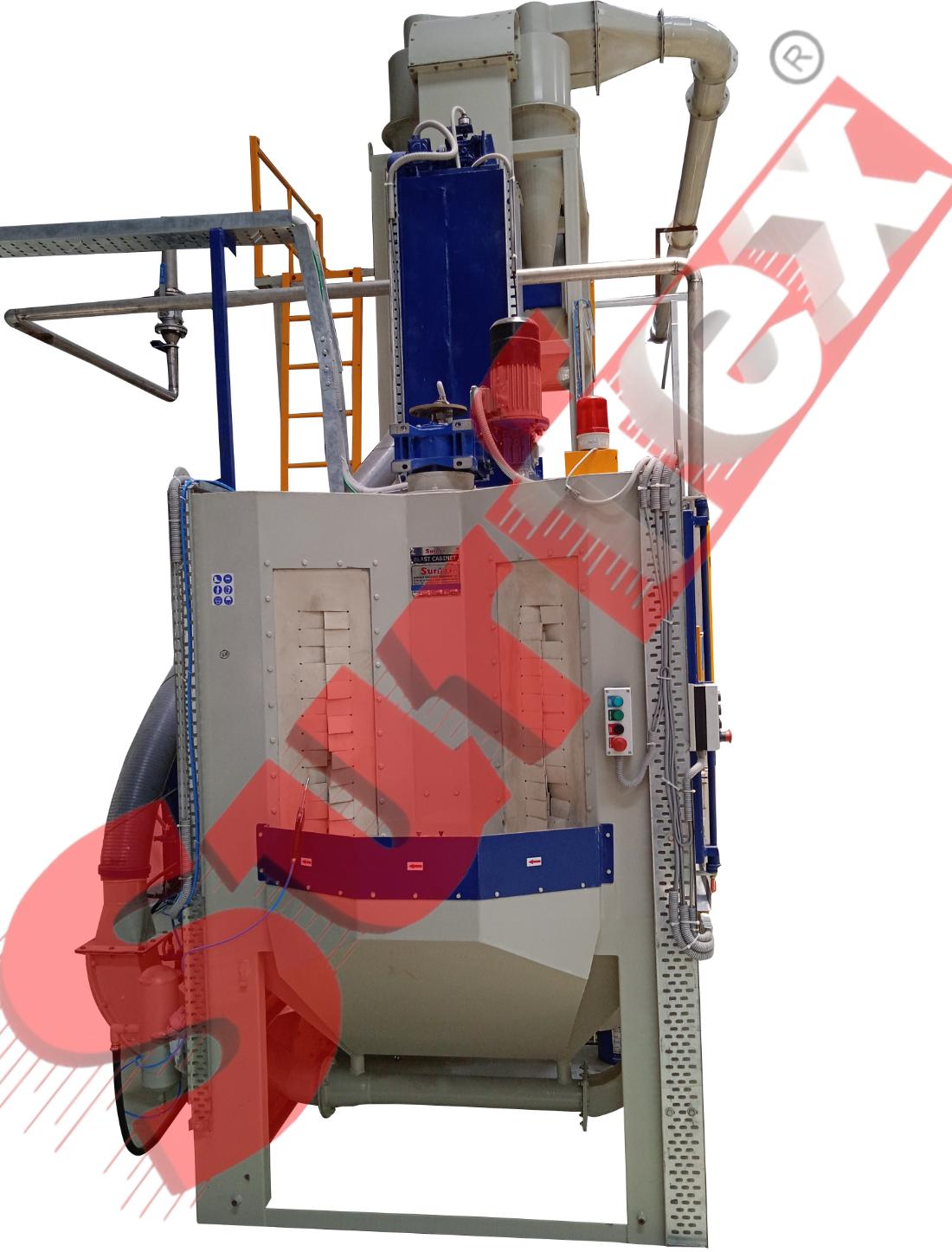
Modern manufacturing industries require efficient surface treatment processes that improve product quality, durability, and production speed. A Hanger Turbine Blast Shot Peen Wheel Machine is one of the most effective solutions for cleaning, strengthening, and preparing large or complex metal components before coating, painting, welding, or assembly.

Designed for industries handling heavy fabricated parts, castings, forgings, and precision-engineered components, this machine combines the power of high-speed turbine blasting with advanced shot peening technology to deliver consistent and repeatable results.  Shot Blasting Machine, Shot Blasting Machine Manufacturers, Robotic Shot Peening Machineshot peening machineRobotic Shot Peening Machine Manufacturers , shot blasting machine manufacturers in india , shot peening machine manufacturers in india, shot peening machine manufacturers, Roll Etching Machine Manufacturers, Shot Peening, Roller Conveyor Type Shot Blasting Machine,

https://sfecindia.net/

https://sfecindia.net/shot-peening-machine.html

https://sfecindia.net/robotic-shot-peening-machine.html


https://sfecindia.net/roller-conveyor-type-shot-blasting-machine.html

https://sfecindia.net/what-is-shot-peening/

What is a Hanger Turbine Blast Shot Peen Wheel Machine?

A Hanger Turbine Blast Shot Peen Wheel Machine is an automated surface treatment system in which components are suspended from rotating hooks or hangers while high-speed blast wheels propel steel shots at the workpiece.

Unlike manual blasting, the rotating hanger exposes every surface to the abrasive stream, ensuring uniform cleaning and controlled shot peening across complex geometries.

This machine is ideal for:

  • Heavy fabricated structures
  • Automotive components
  • Aerospace parts
  • Forged components
  • Steel fabrications
  • Welded assemblies
  • Railway parts
  • Mining equipment
  • Construction machinery
  • Industrial machinery components

How Does the Machine Work?

The process begins by loading components onto specially designed rotating hangers.

Once the chamber door closes:

  1. The hanger rotates continuously.
  2. High-speed turbine blast wheels accelerate steel shots.
  3. Abrasives strike the component surface uniformly.
  4. Rust, scale, contaminants, and welding residues are removed.
  5. Surface compressive stress is generated for shot peening.
  6. Used abrasives are automatically recovered.
  7. Dust is collected through an efficient filtration system.

The entire process is automated, delivering high productivity with minimal operator intervention.

Major Components

A typical Hanger Turbine Blast Shot Peen Wheel Machine includes:

  • Blast cabinet
  • Heavy-duty blast wheels
  • Rotating hanger system
  • Abrasive recovery system
  • Bucket elevator
  • Air wash separator
  • Dust collector
  • PLC control panel
  • Safety interlocks
  • Wear-resistant liners
  • Automatic abrasive recycling system

Key Features

High-Efficiency Blast Wheels

High-performance turbine wheels provide maximum abrasive velocity while minimizing energy consumption.

Uniform Surface Treatment

Rotating hangers ensure complete coverage of every surface.

Automatic Abrasive Recycling

The machine continuously separates reusable steel shots from dust and broken media.

Heavy Load Capacity

Designed for handling large, bulky, and heavy industrial components.

Durable Construction

Wear-resistant liners increase machine life and reduce maintenance costs.

PLC Automation

Modern control systems simplify operation and improve process consistency.

Energy Efficient Design

Optimized turbine technology reduces operating costs while maintaining high productivity.

SFECIndia designs and manufactures advanced surface preparation solutions tailored to customer production requirements. With decades of engineering expertise, the company provides reliable machines featuring robust construction, energy-efficient turbine technology, automated controls, and dependable after-sales support. Every machine is engineered for consistent blasting performance, reduced maintenance, and long service life across demanding industrial applications.

Whether you require a standard configuration or a customized solution for specialized components, SFECIndia offers machines designed to improve productivity, surface quality, and operational efficiency.

How to Find Affordable Shot Blasting Machines Without Sacrificing Quality

Buying a shot blasting machine is a significant investment for any manufacturing, foundry, fabrication, automotive, or steel processing business. While every buyer wants the best price, choosing the cheapest machine can often lead to higher maintenance costs, lower productivity, and frequent downtime. Shot Blasting Machine, Shot Blasting Machine Manufacturers, Robotic Shot Peening Machineshot peening machineRobotic Shot Peening Machine Manufacturers , shot blasting machine manufacturers in india , shot peening machine manufacturers in india, shot peening machine manufacturers, Roll Etching Machine Manufacturers, Shot Peening, Roller Conveyor Type Shot Blasting Machine,

https://sfecindia.net/

https://sfecindia.net/shot-peening-machine.html

https://sfecindia.net/robotic-shot-peening-machine.html


https://sfecindia.net/roller-conveyor-type-shot-blasting-machine.html

https://sfecindia.net/what-is-shot-peening/

The good news is that you don’t have to compromise on quality to find an affordable shot blasting machine. By evaluating the right factors before purchasing, you can invest in equipment that delivers excellent performance, durability, and long-term value.

In this guide, we’ll explain how to choose a cost-effective shot blasting machine that meets your production needs while keeping your operating costs under control.

Why Price Shouldn’t Be the Only Buying Factor

Many businesses compare machines based only on the initial purchase price. However, the real cost of ownership includes:

  • Maintenance expenses
  • Spare parts availability
  • Abrasive consumption
  • Power consumption
  • Machine downtime
  • Operator productivity
  • Service support

A slightly higher-quality machine often becomes much more economical over its lifetime.

Determine Your Production Requirements

Before comparing prices, identify exactly what your application requires.

Consider:

  • Type of workpieces
  • Material being cleaned
  • Daily production volume
  • Component size and weight
  • Required surface finish
  • Automation requirements

Choosing the correct machine prevents overspending on unnecessary features while ensuring sufficient capacity for your production.

Choose the Right Type of Shot Blasting Machine

Different industries require different machine designs.

Common options include:

  • Tumble Belt Shot Blasting Machine
  • Hanger Type Shot Blasting Machine
  • Roller Conveyor Shot Blasting Machine
  • Table Type Shot Blasting Machine
  • Spinner Hanger Shot Blasting Machine
  • Wire Mesh Belt Shot Blasting Machine
  • Pipe Shot Blasting Machine
  • Steel Plate Shot Blasting Machine

Selecting the correct machine improves efficiency and reduces operating costs.

Compare Total Cost of Ownership

Instead of comparing only machine prices, compare the complete lifecycle cost.

A quality industrial shot blasting machine typically offers:

  • Longer equipment life
  • Reduced maintenance
  • Lower abrasive consumption
  • Better cleaning efficiency
  • Less production downtime
  • Lower electricity usage

These savings often outweigh a small difference in purchase price.

Look for High-Quality Components

Affordable does not mean low quality.

A reliable machine should include:

  • Durable blast wheel technology
  • Heavy-duty wear liners
  • Efficient dust collection system
  • Quality electrical components
  • Reliable motors
  • Strong steel construction

Premium components reduce maintenance and increase machine life.

Buy Directly from Experienced Manufacturers

Purchasing directly from a shot blasting machine manufacturer offers several advantages:

  • Competitive factory pricing
  • Better customization options
  • Technical consultation
  • Faster spare parts availability
  • Professional installation support
  • Long-term service assistance

Working with an experienced manufacturer also ensures that the machine is designed specifically for your production process.

Check Energy Efficiency

Energy consumption directly impacts operating costs.

Modern shot blasting machines are designed with:

  • High-efficiency blast turbines
  • Optimized abrasive recycling systems
  • Efficient dust collectors
  • Reduced power consumption
  • Improved airflow management

Lower electricity usage can significantly reduce long-term production expenses.

Verify Spare Parts Availability

Even the best machines require maintenance over time.

Before purchasing, ask:

  • Are spare parts readily available?
  • Is technical support available?
  • How quickly can replacement parts be delivered?
  • Is installation assistance provided?

Reliable after-sales service protects your investment.

Evaluate Automation Features

Automation increases productivity while reducing labor costs.

Depending on your production requirements, consider features such as:

  • Automatic loading systems
  • PLC control panels
  • Touchscreen operation
  • Variable blast wheel speed
  • Automatic abrasive recovery
  • Conveyor integration

These features improve consistency and reduce operating expenses.

Read Customer Reviews and Case Studies

One of the best ways to judge machine quality is by reviewing customer experiences.

Look for manufacturers with successful installations across industries such as:

  • Automotive
  • Aerospace
  • Foundry
  • Steel fabrication
  • Railways
  • Construction equipment
  • Heavy engineering

Positive customer feedback is often a strong indicator of long-term reliability.

Don’t Ignore Warranty and Service

A comprehensive warranty demonstrates confidence in product quality.

Before purchasing, verify:

  • Warranty coverage
  • Installation support
  • Operator training
  • Preventive maintenance services
  • Remote technical support
  • Annual service options

Reliable support helps maximize machine uptime.

Ask for Machine Customization

Every production facility has unique requirements.

Many leading shot blasting machine manufacturers offer customized solutions based on:

  • Component size
  • Production capacity
  • Available floor space
  • Abrasive type
  • Automation level
  • Material handling system

Customization ensures better efficiency without paying for unnecessary features.

Compare Multiple Quotations

Request quotations from several reputable manufacturers and compare:

  • Machine specifications
  • Component quality
  • Production capacity
  • Warranty
  • Service support
  • Delivery time
  • Installation
  • Operating costs

The lowest quotation is not always the best value.

Signs of a Reliable Shot Blasting Machine Manufacturer

Choose manufacturers that offer:

  • Years of industry experience
  • In-house manufacturing
  • Custom engineering
  • International installations
  • Strong technical support
  • Readily available spare parts
  • Quality certifications
  • Proven customer satisfaction

A trusted manufacturer provides confidence that your investment will perform reliably for years.

Final Thoughts

Finding an affordable shot blasting machine is not about choosing the lowest price—it’s about achieving the best value. By focusing on machine quality, energy efficiency, durability, service support, and long-term operating costs, businesses can invest in equipment that delivers reliable performance and higher productivity.

Whether you’re purchasing your first machine or upgrading an existing production line, taking the time to compare manufacturers, evaluate specifications, and understand total ownership costs will help you make a smarter investment.

If you’re looking for dependable and cost-effective shot blasting solutions, SFECIndia manufactures a wide range of industrial shot blasting machines designed for foundries, automotive companies, steel fabrication plants, aerospace manufacturers, and heavy engineering industries. With decades of manufacturing experience, customized solutions, reliable after-sales support, and machines built for long-term performance, SFECIndia helps businesses improve surface preparation while maximizing return on investment.

What Is Abrasive Blasting Equipment and How Does It Work

Surface preparation plays a critical role in manufacturing, construction, automotive, aerospace, and heavy engineering industries. Before painting, coating, welding, or finishing a metal surface, contaminants such as rust, scale, old paint, and dirt must be removed. This is where abrasive blasting equipment becomes essential.

Shot Blasting Machine Manufacturers , Robotic Shot Peening Machineshot peening machineRobotic Shot Peening Machine Manufacturers , shot blasting machine manufacturers in india , shot peening machine manufacturers in india , shot peening machine manufacturers , Shot Peening 

Abrasive blasting equipment is designed to clean, prepare, roughen, or finish surfaces by propelling abrasive media at high speed. The process improves surface quality, enhances coating adhesion, and extends the lifespan of industrial components.

In this article, we will explain what abrasive blasting equipment is, how it works, its major components, applications, and the different types available for industrial use.

What Is Abrasive Blasting Equipment?

Abrasive blasting equipment refers to machines and systems that use compressed air, centrifugal wheels, or water to propel abrasive materials against a surface. The impact of the abrasive particles removes contaminants and creates the desired surface profile.

The equipment can be used for:

  • Rust removal
  • Paint stripping
  • Surface cleaning
  • Descaling
  • Surface texturing
  • Surface preparation before coating
  • Deburring and finishing

Industries use abrasive blasting equipment to improve productivity, maintain quality standards, and increase the durability of finished products.

How Does Abrasive Blasting Equipment Work?

The working principle is relatively simple. Abrasive media is accelerated at high velocity and directed towards the workpiece surface.

The process generally involves the following steps:

1. Abrasive Loading

The selected abrasive media is loaded into the blasting machine. Common abrasives include steel shot, steel grit, aluminum oxide, garnet, glass beads, and sand alternatives.

2. Media Acceleration

The equipment accelerates the abrasive using either:

  • Compressed air
  • Blast wheels
  • Water pressure

3. Surface Impact

The abrasive particles strike the surface at high speed, removing rust, paint, scale, contaminants, and unwanted materials.

4. Surface Finishing

After blasting, the surface becomes clean and develops the required roughness or finish needed for coating, painting, or further processing.

Major Components of Abrasive Blasting Equipment

Blast Cabinet or Blast Chamber

The enclosed area where the blasting operation takes place.

Blast Nozzle

The nozzle directs the abrasive stream towards the surface at high velocity.

Air Compressor

Provides compressed air in air blasting systems.

Blast Pot

Stores and controls the flow of abrasive media.

Dust Collector

Removes dust and airborne particles, maintaining a safe working environment.

Abrasive Recovery System

Collects and recycles reusable abrasive materials, reducing operating costs.

Types of Abrasive Blasting Equipment

Air Blasting Equipment

Uses compressed air to propel abrasives. Commonly used for cleaning and surface preparation.

Wheel Blasting Equipment

Uses rotating blast wheels to throw abrasive media at high speed. Suitable for high-production industrial applications.

Wet Blasting Equipment

Combines water and abrasives to reduce dust and provide smoother finishes.

Portable Blasting Equipment

Designed for on-site applications such as shipyards, construction sites, and maintenance projects.

Blast Rooms

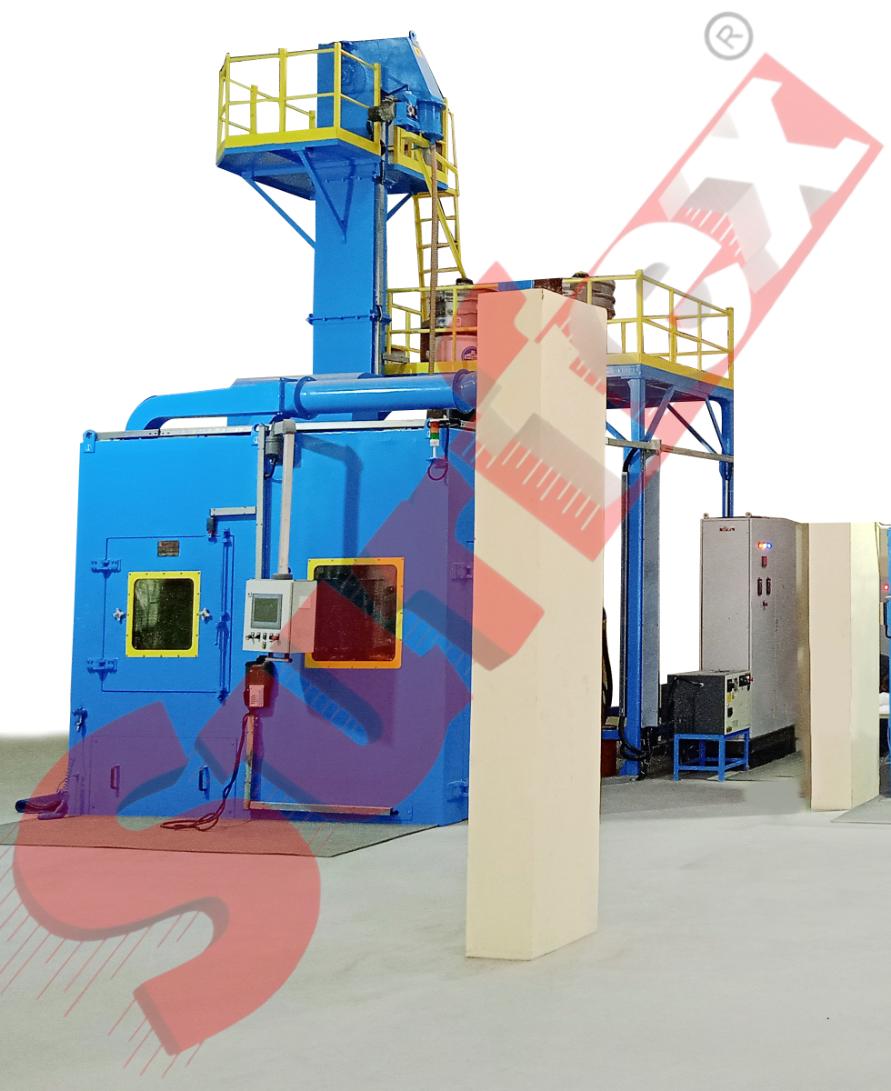
Large enclosed systems used for heavy components, structural steel, and fabricated parts.

Common Abrasive Materials

Various abrasive materials can be used depending on the application:

  • Steel Shot
  • Steel Grit
  • Aluminum Oxide
  • Glass Beads
  • Garnet
  • Ceramic Media
  • Plastic Media

The choice of abrasive depends on the surface material, desired finish, and cleaning requirements.

Applications of Abrasive Blasting Equipment

Abrasive blasting equipment is widely used in numerous industries:

Automotive Industry

Used for cleaning engine components, chassis parts, and wheels.

Steel Industry

Removes mill scale and rust from steel plates and structural sections.

Aerospace Industry

Provides precise surface preparation for aircraft components.

Foundries

Cleans castings and removes sand and scale.

Construction Industry

Prepares steel structures before painting and coating.

Shipbuilding Industry

Removes corrosion and old coatings from ships and marine equipment.

Advantages of Abrasive Blasting Equipment

  • Faster surface cleaning
  • Improved coating adhesion
  • Better surface quality
  • Increased productivity
  • Reduced manual labor
  • Longer component life
  • Consistent finishing results
  • Lower maintenance costs

These benefits make abrasive blasting an essential process in modern manufacturing industries.

How to Choose the Right Abrasive Blasting Equipment

When selecting a machine, consider:

  • Type of material being cleaned
  • Production volume
  • Required surface finish
  • Size of the workpiece
  • Available workspace
  • Dust control requirements
  • Operating costs
  • Automation requirements

Choosing the proper equipment improves efficiency and reduces production expenses.

Future Trends in Abrasive Blasting

Modern abrasive blasting systems are becoming increasingly automated. Industries are adopting:

  • Robotic blasting systems
  • Automated blast rooms
  • Energy efficient machines
  • Dust-free blasting technologies
  • Smart monitoring systems

These innovations improve productivity while reducing labor costs and environmental impact.

Conclusion

Abrasive blasting equipment is an essential industrial solution for cleaning, preparing, and finishing surfaces. By propelling abrasive media at high speed, these machines effectively remove contaminants and create ideal surface conditions for coating, painting, and manufacturing operations.

Whether used in automotive, aerospace, steel fabrication, foundries, or heavy engineering industries, abrasive blasting equipment delivers superior surface quality, higher productivity, and long-term cost savings.

As industrial requirements continue to evolve, modern abrasive blasting technologies will play an even greater role in achieving efficient and reliable surface preparation.

https://docs.google.com/document/d/e/2PACX-1vTU-CRlRkoXDLmOz8Xd_1p9BzTsA34Dw-uZfYjd8Jw-1c2i5qbQ1knMCeQ1ZyTVaouphmlabUNX_aq9/pub

Robotic Shot Peening Machine Purchase Made Easy

In today’s fast-paced manufacturing world, industries are constantly looking for ways to enhance product durability, precision, and cost-efficiency. One of the key processes that supports these objectives is shot peening—a surface treatment technique used to improve the fatigue strength and resistance of components. With advancements in automation, Robotic Shot Peening Machines have revolutionized this process, offering unmatched consistency and precision.  Shot Blasting MachineShot Blasting Machine Manufacturers, Robotic Shot Peening Machineshot peening machineRobotic Shot Peening Machine Manufacturers , shot blasting machine manufacturers in india , shot peening machine manufacturers in india, shot peening machine manufacturers, Roll Etching Machine Manufacturers, Roll Texturing Machine Manufacturers, Shot blasting machine manufacturer, shot blasting machine manufacturers in asia, CNC Shot peening Machine

https://sfecindia.net/

https://sfecindia.net/shot-peening-machine.html

https://sfecindia.net/robotic-shot-peening-machine.html

https://sfecindia.net/roll-etching-machine.html

https://sfecindia.net/shot-peening-for-gears.html

If you are considering investing in a robotic shot peening machine, Surfexindia makes the purchase journey seamless, efficient, and tailored to your needs. This article will guide you through the importance of robotic shot peening, the advantages of buying from Surfexindia, and how they simplify the entire procurement process for industries worldwide.

Understanding Robotic Shot Peening Machines

Shot peening is a mechanical process where small spherical media (called shots) are blasted onto a component’s surface to induce compressive stresses. This strengthens the material, improves fatigue life, and prevents cracks or corrosion.

Traditional shot peening methods required manual operations, which often lacked consistency. With automation and robotics, industries can now benefit from precision-controlled peening, ensuring every part receives uniform treatment.

A Robotic Shot Peening Machine integrates robotic arms with advanced software to deliver:

  • Accurate coverage and intensity control

  • Consistency across large production batches

  • Adaptability for complex geometries and aerospace-grade components

  • Reduced labor dependency and higher safety standards

Why Industries Prefer Robotic Shot Peening

Several industries today—from aerospace, automotive, power generation, railways, and defense—depend heavily on robotic shot peening for critical components such as turbine blades, gears, crankshafts, and landing gear parts.

Here are some reasons why robotic shot peening has become the preferred choice:

Enhanced Product Life – By reducing surface stress and preventing fatigue cracks, components last significantly longer.

Cost Efficiency – Reduced rework and fewer failures save both time and money.

Automation Benefits – High repeatability, accuracy, and minimal downtime.

Safety and Sustainability – Advanced dust collection systems make the process eco-friendly and safer for operators.

Surfexindia: Your Trusted Partner in Robotic Shot Peening

When it comes to buying a Robotic Shot Peening Machine, one of the biggest challenges industries face is choosing the right supplier. Factors like machine customization, after-sales service, installation support, and cost transparency play a major role in the purchase decision.

This is where Surfexindia stands out. Known as one of the leading manufacturers and suppliers of surface preparation and finishing equipment, Surfexindia has built a reputation for delivering high-quality, customized, and reliable robotic shot peening machines.

Key Advantages of Buying from Surfexindia:

  • Customized Solutions: Machines designed to meet the specific requirements of industries such as aerospace, automotive, and defense.

  • Advanced Technology: Integration of state-of-the-art robotics, automation controls, and precise monitoring systems.

  • Proven Reliability: Machines built with durable components for long operational life.

  • Global Standards: Compliance with international quality standards ensures world-class performance.

  • After-Sales Support: Installation, operator training, spare parts supply, and regular maintenance support.

  • Competitive Pricing: Cost-effective solutions without compromising quality.

Making the Purchase Process Easy

Surfexindia understands that buying a robotic shot peening machine is a significant investment for any industry. To make the process smooth and hassle-free, they follow a step-by-step approach:

Consultation & Requirement Analysis

The process begins with understanding your exact needs—whether you need a machine for turbine blades, gears, or large aerospace parts. Their experts analyze production requirements, part geometry, and desired peening intensity.

Customized Design & Proposal

Based on your input, Surfexindia designs a tailor-made solution that fits your production setup. You receive a clear proposal outlining machine specifications, costs, and expected ROI.

Manufacturing & Quality Testing

The machine is manufactured under strict quality standards. Before delivery, it undergoes rigorous testing to ensure performance and reliability.

Delivery & Installation

Surfexindia ensures safe transportation and professional installation at your facility. Their team helps integrate the machine seamlessly into your production line.

Training & Support

Operators and staff are trained to handle the machine efficiently. Continuous technical support and maintenance keep downtime minimal.

Applications of Robotic Shot Peening Machines

Robotic shot peening is used across multiple sectors, including:

  • Aerospace Industry – Aircraft turbine blades, landing gear, and engine parts.

  • Automotive Industry – Gears, crankshafts, suspension springs, and connecting rods.

  • Power Generation – Gas and steam turbine components.

  • Defense & Railways – Armored vehicle parts, railway axles, and bogies.

By choosing Surfexindia, industries can ensure that their components not only meet global safety standards but also perform optimally in challenging environments.

Why Choose Surfexindia for Your Next Investment?

Purchasing a robotic shot peening machine is not just about buying equipment—it’s about building a long-term partnership. Surfexindia ensures that every client receives:

  • A machine tailored to their exact requirements.

  • End-to-end assistance from consultation to after-sales support.

  • High ROI through durable machines and reduced maintenance costs.

  • Faster project turnaround thanks to a streamlined procurement process.

Their machines are not only built for performance but also designed with user-friendliness in mind, making them easy to operate and maintain.

Final Thoughts

The global manufacturing landscape is evolving rapidly, and staying competitive requires adopting advanced technologies like Robotic Shot Peening Machines. Whether you’re in aerospace, automotive, or power generation, investing in a reliable machine is crucial to maintaining quality and efficiency.

With Surfexindia, purchasing a robotic shot peening machine becomes straightforward, transparent, and beneficial in the long run. Their customized solutions, advanced technology, and commitment to customer success ensure that industries get maximum value from their investment.

If you are ready to take your manufacturing processes to the next level, Surfexindia is your trusted partner for robotic shot peening machines—making the purchase journey simple, reliable, and rewarding.

Robotic Shot Peening Machine Purchase Made Easy with Surfexindia

In today’s fast-paced manufacturing world, industries are constantly looking for ways to enhance product durability, precision, and cost-efficiency. One of the key processes that supports these objectives is shot peening—a surface treatment technique used to improve the fatigue strength and resistance of components. With advancements in automation, Robotic Shot Peening Machines have revolutionized this process, offering unmatched consistency and precision.  Shot Blasting MachineShot Blasting Machine Manufacturers, Robotic Shot Peening Machineshot peening machineRobotic Shot Peening Machine Manufacturers , shot blasting machine manufacturers in india , shot peening machine manufacturers in india, shot peening machine manufacturers, Roll Etching Machine Manufacturers, Roll Texturing Machine Manufacturers, Shot blasting machine manufacturer, shot blasting machine manufacturers in asia, CNC Shot peening Machine

https://sfecindia.net/

https://sfecindia.net/shot-peening-machine.html

https://sfecindia.net/robotic-shot-peening-machine.html

https://sfecindia.net/roll-etching-machine.html

https://sfecindia.net/shot-peening-for-gears.html

If you are considering investing in a robotic shot peening machine, Surfexindia makes the purchase journey seamless, efficient, and tailored to your needs. This article will guide you through the importance of robotic shot peening, the advantages of buying from Surfexindia, and how they simplify the entire procurement process for industries worldwide.

Understanding Robotic Shot Peening Machines

Shot peening is a mechanical process where small spherical media (called shots) are blasted onto a component’s surface to induce compressive stresses. This strengthens the material, improves fatigue life, and prevents cracks or corrosion.

Traditional shot peening methods required manual operations, which often lacked consistency. With automation and robotics, industries can now benefit from precision-controlled peening, ensuring every part receives uniform treatment.

A Robotic Shot Peening Machine integrates robotic arms with advanced software to deliver:

  • Accurate coverage and intensity control

  • Consistency across large production batches

  • Adaptability for complex geometries and aerospace-grade components

  • Reduced labor dependency and higher safety standards

Why Industries Prefer Robotic Shot Peening

Several industries today—from aerospace, automotive, power generation, railways, and defense—depend heavily on robotic shot peening for critical components such as turbine blades, gears, crankshafts, and landing gear parts.

Here are some reasons why robotic shot peening has become the preferred choice:

Enhanced Product Life – By reducing surface stress and preventing fatigue cracks, components last significantly longer.

Cost Efficiency – Reduced rework and fewer failures save both time and money.

Automation Benefits – High repeatability, accuracy, and minimal downtime.

Safety and Sustainability – Advanced dust collection systems make the process eco-friendly and safer for operators.

Surfexindia: Your Trusted Partner in Robotic Shot Peening

When it comes to buying a Robotic Shot Peening Machine, one of the biggest challenges industries face is choosing the right supplier. Factors like machine customization, after-sales service, installation support, and cost transparency play a major role in the purchase decision.

This is where Surfexindia stands out. Known as one of the leading manufacturers and suppliers of surface preparation and finishing equipment, Surfexindia has built a reputation for delivering high-quality, customized, and reliable robotic shot peening machines.

Key Advantages of Buying from Surfexindia:

  • Customized Solutions: Machines designed to meet the specific requirements of industries such as aerospace, automotive, and defense.

  • Advanced Technology: Integration of state-of-the-art robotics, automation controls, and precise monitoring systems.

  • Proven Reliability: Machines built with durable components for long operational life.

  • Global Standards: Compliance with international quality standards ensures world-class performance.

  • After-Sales Support: Installation, operator training, spare parts supply, and regular maintenance support.

  • Competitive Pricing: Cost-effective solutions without compromising quality.

Making the Purchase Process Easy

Surfexindia understands that buying a robotic shot peening machine is a significant investment for any industry. To make the process smooth and hassle-free, they follow a step-by-step approach:

Consultation & Requirement Analysis

The process begins with understanding your exact needs—whether you need a machine for turbine blades, gears, or large aerospace parts. Their experts analyze production requirements, part geometry, and desired peening intensity.

Customized Design & Proposal

Based on your input, Surfexindia designs a tailor-made solution that fits your production setup. You receive a clear proposal outlining machine specifications, costs, and expected ROI.

Manufacturing & Quality Testing

The machine is manufactured under strict quality standards. Before delivery, it undergoes rigorous testing to ensure performance and reliability.

Delivery & Installation

Surfexindia ensures safe transportation and professional installation at your facility. Their team helps integrate the machine seamlessly into your production line.

Training & Support

Operators and staff are trained to handle the machine efficiently. Continuous technical support and maintenance keep downtime minimal.

Applications of Robotic Shot Peening Machines

Robotic shot peening is used across multiple sectors, including:

  • Aerospace Industry – Aircraft turbine blades, landing gear, and engine parts.

  • Automotive Industry – Gears, crankshafts, suspension springs, and connecting rods.

  • Power Generation – Gas and steam turbine components.

  • Defense & Railways – Armored vehicle parts, railway axles, and bogies.

By choosing Surfexindia, industries can ensure that their components not only meet global safety standards but also perform optimally in challenging environments.

Why Choose Surfexindia for Your Next Investment?

Purchasing a robotic shot peening machine is not just about buying equipment—it’s about building a long-term partnership. Surfexindia ensures that every client receives:

  • A machine tailored to their exact requirements.

  • End-to-end assistance from consultation to after-sales support.

  • High ROI through durable machines and reduced maintenance costs.

  • Faster project turnaround thanks to a streamlined procurement process.

Their machines are not only built for performance but also designed with user-friendliness in mind, making them easy to operate and maintain.

Final Thoughts

The global manufacturing landscape is evolving rapidly, and staying competitive requires adopting advanced technologies like Robotic Shot Peening Machines. Whether you’re in aerospace, automotive, or power generation, investing in a reliable machine is crucial to maintaining quality and efficiency.

With Surfexindia, purchasing a robotic shot peening machine becomes straightforward, transparent, and beneficial in the long run. Their customized solutions, advanced technology, and commitment to customer success ensure that industries get maximum value from their investment.

If you are ready to take your manufacturing processes to the next level, Surfexindia is your trusted partner for robotic shot peening machines—making the purchase journey simple, reliable, and rewarding.

How to Select the Right Grit Size for Your Shot Blasting Machine Materials

Shot blasting machines are widely used in industries like automotive, aerospace, construction, and foundries to clean, strengthen, or prepare metal surfaces. One of the most important factors that determines the success of shot blasting is the grit size of the abrasive material. Choosing the wrong grit can lead to poor surface finish, material damage, or reduced efficiency. That’s why understanding how to select the right grit size for your shot blasting machine materials is crucial. Shot Blasting MachineShot Blasting Machine Manufacturers, Robotic Shot Peening Machineshot peening machineRobotic Shot Peening Machine Manufacturers , shot blasting machine manufacturers in india , shot peening machine manufacturers in india, shot peening machine manufacturers, Roll Etching Machine Manufacturers, Roll Texturing Machine Manufacturers, Shot blasting machine manufacturer, shot blasting machine manufacturers in asia, CNC Shot peening Machine

https://sfecindia.net/

https://sfecindia.net/shot-peening-machine.html

https://sfecindia.net/robotic-shot-peening-machine.html

https://sfecindia.net/roll-etching-machine.html

https://sfecindia.net/shot-peening-for-gears.html

What is Grit Size in Shot Blasting?

Grit size refers to the particle size of the abrasive media used in a shot blasting process. It determines how aggressive the blasting action will be. Smaller grit numbers (coarse grit) mean larger particles, which cut deeper but leave a rougher finish. Higher grit numbers (fine grit) mean smaller particles, which produce a smoother surface but may require more time to remove heavy contaminants.

Why is Grit Size Selection Important?

The grit size you choose impacts:

  • Surface Finish – Whether you want a rough or smooth texture.

  • Cleaning Efficiency – Speed of removing rust, scale, paint, or coatings.

  • Material Protection – Preventing unnecessary wear or damage.

  • Machine Productivity – Ensuring optimal blasting time and reduced abrasive consumption.

Factors to Consider When Selecting Grit Size

Type of Material Being Processed

  • Steel, Iron, and Hard Metals – Coarser grit (e.g., G25–G40) works well for cleaning and descaling.

  • Aluminum and Soft Metals – Finer grit (e.g., G80–G120) prevents damage and produces a smooth finish.

  • Concrete or Stone – Medium grit is effective for surface texturing.

Surface Preparation Requirement

  • Heavy Rust, Scale, or Old Coating Removal – Larger grit is ideal as it cuts faster.

  • Smooth Finishing Before Painting or Coating – Use finer grit for a uniform, polished look.

  • Shot Peening Applications – Typically use smaller grit sizes to create compressive stress without surface damage.

Blasting Machine Type

  • Wheel Blast Machines – Work best with medium to coarse grit for heavy-duty cleaning.

  • Air Blast Machines – Allow greater control, suitable for fine grit applications.

Surface Roughness (Ra Value) Requirement

  • For coatings like paint or powder coating, a moderate roughness ensures better adhesion.

  • For precision industries (aerospace, medical), a very fine grit may be required to maintain dimensional accuracy.

General Grit Size Recommendations

  • Coarse Cleaning (Rust, Scale, Welding Slag): G16 – G40

  • Surface Preparation for Coatings: G40 – G80

  • Fine Finishing / Peening Applications: G80 – G120

Tips for Choosing the Right Grit Size

Always check the specifications of your blasting machine and abrasive compatibility.

Match the grit size with your coating or finishing requirement.

Conduct a trial blasting with different grit sizes to compare surface finishes.

Consider abrasive recycling and consumption – coarse grit tends to last longer but may wear faster on softer materials.

Selecting the right grit size for your shot blasting machine materials is essential for achieving the desired surface quality, protecting your workpieces, and improving efficiency. By considering material type, required finish, machine compatibility, and industry standards, you can make an informed choice. Companies like Sfecindia offer high-quality shot blasting machines and abrasive solutions tailored to your industrial needs, ensuring maximum productivity and precision.